
The Best Smartwatch for Health Tracking: What Actually Matters
Let's be real — most smartwatch reviews bury you in specs you don't care about. You just want something that tracks your health without being a pain to use.
So here's what actually matters when picking a health tracking smartwatch, and what you can safely ignore.
Why Health Tracking on Your Wrist Works
Your phone can do a lot, but it can't track your heart rate while you sleep. That's where a smartwatch earns its spot.
About 70% of people buying smartwatches in 2024 said health features were the main reason. Not notifications. Not apps. Health. And 83% actually use those features regularly — which is rare for any tech product.
The point isn't to turn you into a data nerd. It's to give you a simple way to see how your body's doing without booking a doctor's appointment.
The Only Health Metrics You Need to Care About
Smartwatch companies love adding sensors. Most of them you'll never use. Here's what's actually useful:
Heart Rate (24/7)
Not just during workouts — all day. This gives you a baseline resting heart rate, which is one of the best indicators of your overall fitness. If it spikes when you're sitting on the couch, something's off. Could be stress, bad sleep, or getting sick.
Blood Oxygen (SpO2)
This tells you how well oxygen is moving through your body. Useful for:
- Seeing how you recover after hard workouts
- Checking how you're adjusting to high altitude
- Spotting potential sleep issues (if it drops overnight, you might have breathing problems while you sleep)
Sleep Tracking
Not just "you slept 7 hours." You want light, deep, and REM stages broken down. This is when your body actually repairs itself. A good sleep score connects the dots — like showing you that late coffee wrecked your deep sleep.
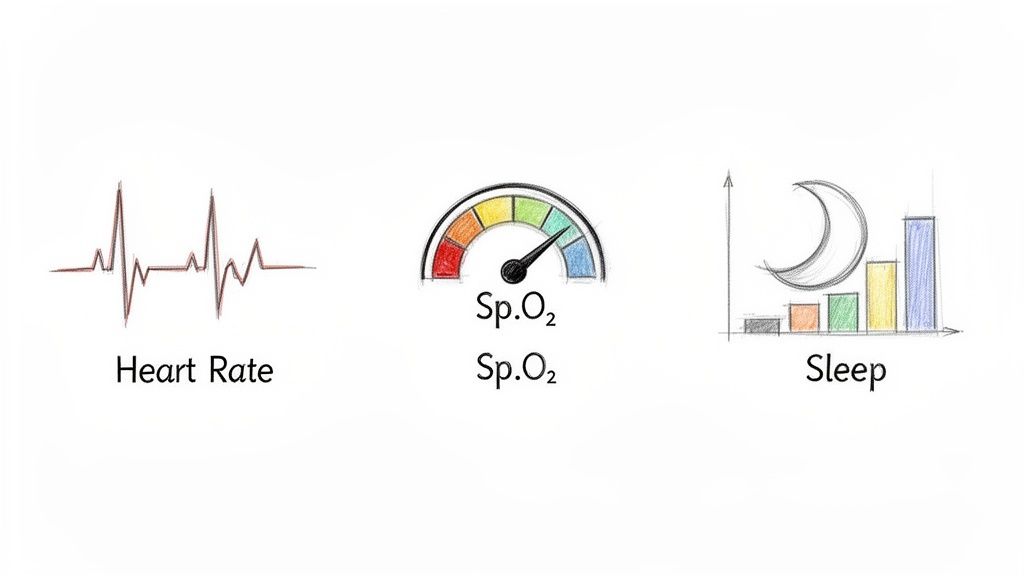
That's it. Heart rate, SpO2, sleep. Everything else is bonus.
The Battery Problem Nobody Talks About
Here's the thing: all those fancy sensors drain battery. Fast.
If your watch dies every night, you can't track sleep. And sleep tracking is arguably the most valuable feature. So what's the point?
Always-on displays, constant GPS, and endless notifications are the main culprits. They turn a 10-day battery into a daily charging routine.
For most people, aim for 7-15 days of battery life. That way you're not constantly plugging it in, and you actually get continuous data — including overnight.
Fit Matters More Than You Think
This sounds basic, but a loose watch gives you garbage data.
The sensors work by shining light through your skin to read blood flow. If the watch is sliding around or there's a gap, ambient light gets in and throws everything off.
Wear it snug. Not tight enough to leave marks, but tight enough that it doesn't move when you shake your wrist. That one change can fix most accuracy issues.
The App Is Half the Product
The watch collects data. The app makes sense of it.
A bad app dumps numbers on you. A good app shows you patterns — like your resting heart rate dropping over a month of exercise, or your sleep quality tanking during stressful weeks.
Before you buy, check reviews of the companion app. If people complain it's buggy or confusing, that's a red flag. Also make sure it works with your phone (iOS or Android) and syncs with any other health apps you use.
What to Look For: The Short Version
| Feature | What You Want |
|---|---|
| Heart rate | 24/7 monitoring, not just workouts |
| SpO2 | Automatic overnight readings |
| Sleep | Stages broken down (light, deep, REM) |
| Battery | 7+ days minimum |
| Display | Readable in sunlight |
| App | Clean interface, shows trends clearly |
Skip watches that have 50 features but die in 2 days. You won't use most of those features anyway.
The Tinymoose Tempo
If you want something that does the basics really well without over complicating things, take a look at the Tempo.
It's got a bright AMOLED screen, 24/7 heart rate and SpO2 tracking, detailed sleep analysis, and a 15-day battery. No gimmicks. It just works.
The 15-day battery is the standout. You actually forget to charge it because you don't need to. And that means you never miss sleep data.
It's not trying to replace your phone. It's trying to give you useful health info without being annoying about it, thats what the best smartwatch does.
Check out the full Tempo Smartwatch review if you want the details.
Common Questions
Are smartwatch health readings accurate?
For tracking trends over time? Yes, pretty accurate. For medical diagnosis? No — and they're not meant to be. The value is seeing patterns, like your resting heart rate improving over weeks of exercise.
Do I need all the premium features like ECG?
Probably not. ECG is useful if you have specific heart concerns, but for general health tracking, heart rate + SpO2 + sleep covers most people. The premium features usually come with shorter battery life and higher prices.
Will it work with my phone?
Most smartwatches work with both iPhone and Android now. The Tempo does. But always double-check before buying — some brands (Apple) lock you into their ecosystem.


Share:
The Best iPad Stylus for Drawing: A Practical Guide for Artists
Best Stylus for iPad in 2026: Tested & Ranked